

Getting Started
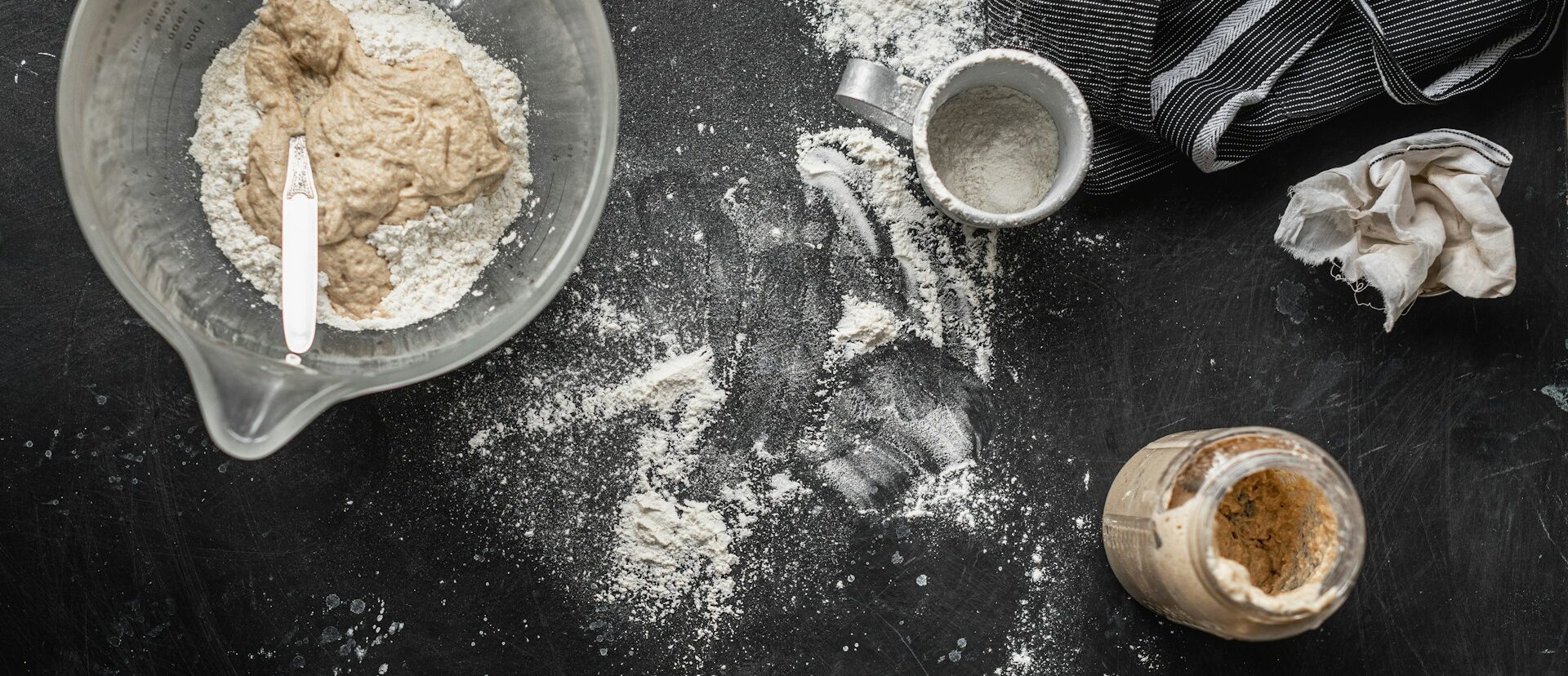
Activating the Starter
Please read carefully, as errors generally occur from not following these simple steps.
Step 1: Select a container that holds at least ½ gallon or with a lid, you can adjust it to secure but not airtight, a large bowl with a plate as a lid would also work. The container should be washed thoroughly, with no soap or bleach remaining in the container. Here at the bakery, we use ½-gallon glass containers with loose-fitting fitting lids. The lid should be loose enough for air to escape, (CO2) but tight enough to keep out contaminants.
Step 2: Pour the entire dried starter contents (about a tablespoon) into the above container. Add about 4 tablespoons of room temperature or warm water (not hot) into the container and stir. Wait about 1 or 2 hours for the starter to be thoroughly softened before proceeding further.
Step 3: After you’ve waited about an hour, add about ½, or 75gr of white flour and ½ cup 106 gr of water, stir thoroughly, attached the lid loosely, and set in a warm place, (Not over 90 degrees F.) for a period of six to ten hours (overnight). The starter should show some bubbling activity after this period.
Step 4: Add 1 cup of white flour and ¾ 159 gr cup of warm (not hot) water, stir thoroughly, attach the lid loosely, and again set in a warm place for a period of six to ten hours. You should be able to see the live starter showing bubbles mixed in the starter. I usually let the site overnight.
Step 5: Add 1 cup of white flour and 1cup of warm water, stir thoroughly, making sure to scrape the starter that has stuck to the side of your container and stir it back into the mixture, attach the lid loosely, and set once again set in a warm place for six to ten hours. Your starter should have a volume of about 2 cups, with a consistency similar to thick pancake batter. (BTW you can now cook sourdough pancakes in this mixture. The starter is now ready to use for baking! You can store this starter in the refrigerator for up to 10 days or so.
Tip from the Baker:
Sourdough yeast rises best between temperatures of 82°F and 90°F. Temperatures below this range slow down the process, while temperatures above 90°F can kill the yeast and halt the process entirely.
The problem is almost always due to insufficient heat. Sourdough is different from instant yeast; it needs to be kept above 80°F. Sourdough yeast does not die at lower temperatures, but it becomes very slow to produce bubbles. If you don’t have a warm place to keep the dough, consider using electric germination mats.
Happy baking!
Jeff
Making a Sourdough sourer
Maintain your starter at a lower hydration lever. This means using higher ratios of flour to water. Use whole-grain flours, which the acid-producing bacteria love. Keep the hooch or brown liquid layer that forms on a hungry sourdough starter instead of pouring it off.
Starter Maintenance
If the starter has been unused in the refrigerator for a period of about 14 days, remove it from the refrigerator, pour off any alcohol that has risen to the top, stir thoroughly, and discard ½ the starter. Add about ½ cup of flour and ¼ cup of water to bring the volume back up to 1 ½ cups and stir completely, making sure to scrape the sides of the container back into the mix. Here we actually keep our starters at about a 2-cup level.